

How IPTV technology works is one of the most misunderstood topics in digital streaming today. Most users enjoy IPTV every day. However, very few understand what happens behind the scenes.
In 2026, IPTV technology has evolved significantly. It now supports ultra-HD streaming, adaptive bitrate delivery, multi-device compatibility, and low-latency transmission.
So how does IPTV actually work?
In simple terms, IPTV (Internet Protocol Television) delivers television content over the internet instead of traditional cable or satellite systems. But technically, the process is much more advanced.
This guide explains everything step by step.
You will learn:
- What IPTV really is
- The core components behind IPTV systems
- How content travels from servers to your device
- The role of streaming protocols
- Why internet speed matters
- How IPTV differs from cable and OTT
- Common technical issues and solutions
Let’s break it down.
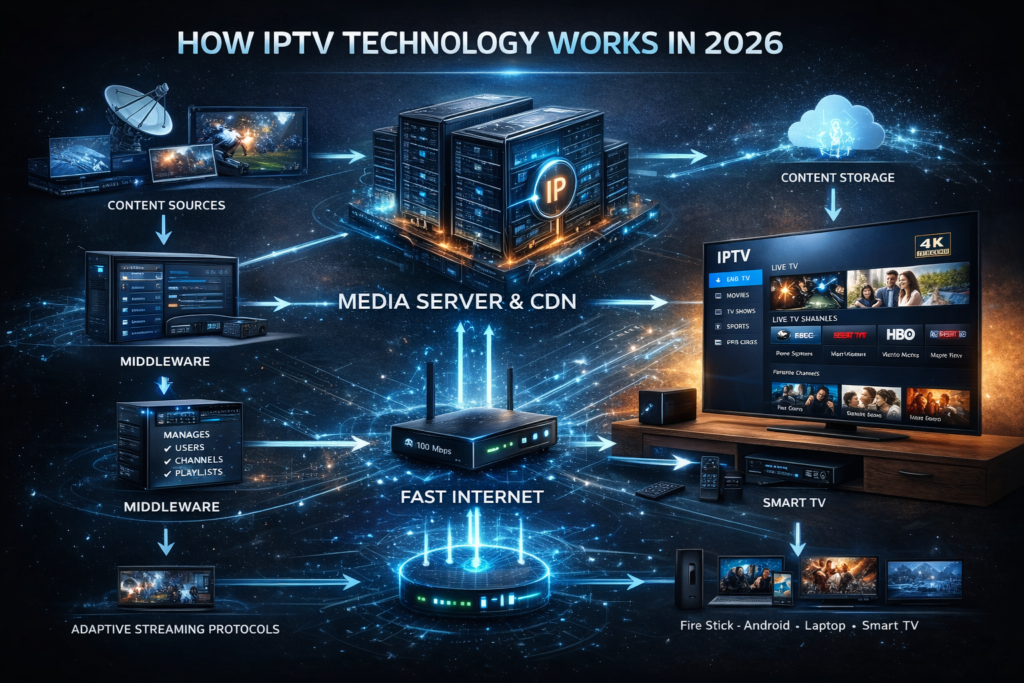
Table of Contents
- What Is IPTV?
- How IPTV Technology Works (Step-by-Step)
- Key Components of an IPTV System
- Streaming Protocols Explained
- Types of IPTV Services
- IPTV vs Cable vs OTT
- Why Internet Speed Matters
- How IPTV Handles 4K & 8K in 2026
- Common IPTV Technical Issues
- Security & Data Protection
- The Future of IPTV Technology
- FAQ
- Conclusion
What Is IPTV?
IPTV (Internet Protocol Television) is a system that delivers TV channels and video content using internet protocol networks instead of satellite signals or cable infrastructure.
Unlike traditional broadcasting, IPTV streams content through data packets over a broadband connection.
This allows:
- On-demand viewing
- Multi-device streaming
- Interactive features
- Time-shifted content
IPTV is not the same as Netflix or YouTube. It can replicate live TV channels exactly like cable but through internet servers.
How IPTV Technology Works (Step-by-Step)
Let’s simplify the technical flow.
Step 1: Content Acquisition
First, IPTV providers acquire TV channels and video content from broadcasters.
This includes:
- Live TV feeds
- Sports events
- Movies
- Series libraries
The content is received via satellite, fiber networks, or direct licensing feeds.
Step 2: Encoding & Compression
Raw video signals are extremely large.
Therefore, they must be compressed using codecs such as:
- H.264 (AVC)
- H.265 (HEVC)
- AV1 (increasingly used in 2026)
Compression reduces file size while preserving quality.
This step is critical for smooth streaming.
Step 3: Content Storage & Servers
After encoding, content is:
- Stored on powerful media servers
- Distributed via CDN (Content Delivery Networks)
CDNs ensure users receive content from the nearest server location. This reduces latency and buffering.
Step 4: Streaming via Internet Protocol
When you select a channel:
- Your IPTV app sends a request.
- The server responds with streaming data packets.
- Your device decodes the packets.
- The video plays in real time.
Everything happens in milliseconds.
Step 5: Adaptive Bitrate Streaming
Modern IPTV in 2026 uses adaptive bitrate technology.
This means:
- If your internet speed drops → quality lowers automatically.
- If speed improves → quality increases instantly.
This prevents constant buffering.
Key Components of an IPTV System
To fully understand how IPTV technology works, we must look at system architecture.
1. Content Source
Broadcasters and studios provide raw feeds.
2. Encoder
Compresses video into digital format.
3. Middleware
The control center of IPTV.
Manages:
- User accounts
- Channel lists
- EPG (Electronic Program Guide)
- Billing systems
4. Media Servers
Deliver video streams.
5. CDN
Distributes content geographically.
6. End User Device
Such as:
- Smart TV
- Firestick
- Android TV box
- Smartphone
- PC
Each component plays a role in the final viewing experience.
Streaming Protocols Explained
IPTV relies on specific streaming protocols.
HTTP Live Streaming (HLS)
- Most common
- Reliable
- Compatible with most devices
MPEG-DASH
- Adaptive streaming
- High performance
RTSP (Real-Time Streaming Protocol)
- Lower latency
- Used for live feeds
UDP Multicast (for managed networks)
- Efficient for large-scale ISP IPTV
Protocols determine:
- Latency
- Stability
- Compatibility
Types of IPTV Services
IPTV is divided into three main categories.
1. Live IPTV
Real-time TV channels.
Sports, news, events.
2. Video on Demand (VOD)
Movies and series libraries.
User chooses what to watch.
3. Time-Shifted IPTV
Allows:
- Pause live TV
- Replay programs
- Catch-up content
Each type uses similar infrastructure but different delivery logic.
IPTV vs Cable vs OTT
Understanding differences helps clarify IPTV’s position.
IPTV
- Internet-based
- Requires app or middleware
- Often customizable
Cable TV
- Coaxial infrastructure
- Fixed channel packages
- Hardware dependent
OTT Platforms
- Netflix, Disney+, etc.
- App-based only
- No live broadcast replication
IPTV bridges live TV and internet streaming.
Why Internet Speed Matters
Your internet connection determines:
- Video quality
- Buffering frequency
- Stability
Recommended speeds in 2026:
- SD: 5 Mbps
- HD: 10 Mbps
- 4K: 25 Mbps
- 8K: 50+ Mbps
Low latency also improves channel switching speed.
How IPTV Handles 4K & 8K in 2026
Thanks to HEVC and AV1 codecs, IPTV now supports ultra-high definition.
However, this requires:
- Strong servers
- Optimized encoding
- Reliable CDN distribution
- High-speed fiber internet
Without these, buffering increases dramatically.
Common IPTV Technical Issues
Even advanced systems face problems.
1. Buffering
Causes:
- Slow internet
- Server overload
- Wi-Fi interference
2. Freezing
Often codec-related or device RAM issue.
3. Channel Not Loading
May be server downtime or playlist error.
4. Audio Sync Problems
Encoding misalignment.
Understanding the technical flow helps diagnose issues quickly.
Security & Data Protection
IPTV technology in 2026 includes:
- Encrypted streaming (HTTPS)
- Secure login authentication
- Anti-piracy watermarking
- VPN compatibility (user-side)
Security protects both providers and users.
The Future of IPTV Technology
IPTV is evolving toward:
- AI-based content recommendations
- Cloud DVR systems
- Ultra-low latency sports streaming
- Integrated smart home controls
- 8K mass adoption
Fiber internet expansion in the USA will further accelerate IPTV growth.
FAQ- how IPTV works
What is IPTV in simple words?
IPTV delivers television content using internet protocol networks instead of traditional cable or satellite systems.
Does IPTV require satellite?
No. IPTV works through broadband internet only.
Is IPTV better than cable?
Technically, IPTV offers more flexibility and on-demand control. However, stability depends on internet quality.
Why does IPTV buffer?
Buffering usually happens due to slow internet, overloaded servers, or Wi-Fi interference.
Can IPTV stream 4K?
Yes. Modern IPTV systems support 4K and even 8K, provided internet speed is sufficient.
What devices support IPTV?
Smart TVs, Android TV boxes, Firestick, smartphones, tablets, and PCs.
Conclusion
So Now you understand how IPTV technology works in 2026.
It is not just streaming. It is a complex system involving:
- Content acquisition
- Encoding
- Middleware management
- Server infrastructure
- Adaptive bitrate protocols
When optimized correctly, IPTV delivers a flexible and powerful viewing experience.
To conclude, If you want to explore how IPTV subscription plans differ in features, devices, and support, read our detailed comparison guide next.
